How to Grow a Healthcare or Medical Practice Without Hiring More Staff
Growth creates an uncomfortable question for independent medical practices: how do you take on more patients without automatically adding more people to the payroll?
Hiring might eventually be the right call. But before you add another salary, another round of training, another person to manage, it's worth asking a different question first: is your practice actually out of capacity, or are your current systems just eating up capacity that's already there?
That's not a rhetorical distinction. It changes what you do next.
A front desk can look understaffed when the real problem is a few hundred small manual tasks piling up — answering the same three questions on repeat, chasing confirmations, re-typing patient information that was already submitted once, sending reminders by hand, checking statuses, returning voicemails, moving information between two systems that don't talk to each other. Add another employee into that mess and you'll get relief for a while. But if the workflow underneath it doesn't change, the same problem shows up again at the next growth spurt — just with a bigger payroll attached to it.
So before opening a job requisition, it's worth mapping what your team is actually spending its time on.
Start with the work, not the headcount
Look for the tasks that are repetitive, high-volume, rules-based, frequently delayed, or dependent on someone remembering to do the next step. Those are usually your best opportunities to free up capacity — not because the work is unimportant, but because it doesn't need a skilled person doing it manually.
That doesn't mean automating everything. A lot of what happens in a healthcare practice requires judgment, empathy, and clinical knowledge that no workflow tool replaces, and that's exactly where your team's time is best spent. The goal is to clear out the unnecessary work sitting around those interactions, not to remove the interactions themselves.
A useful test for any given task: does a person need to do this, or does a person just happen to be doing it today because nobody's redesigned the process?
The phone is usually the easiest place to see the problem
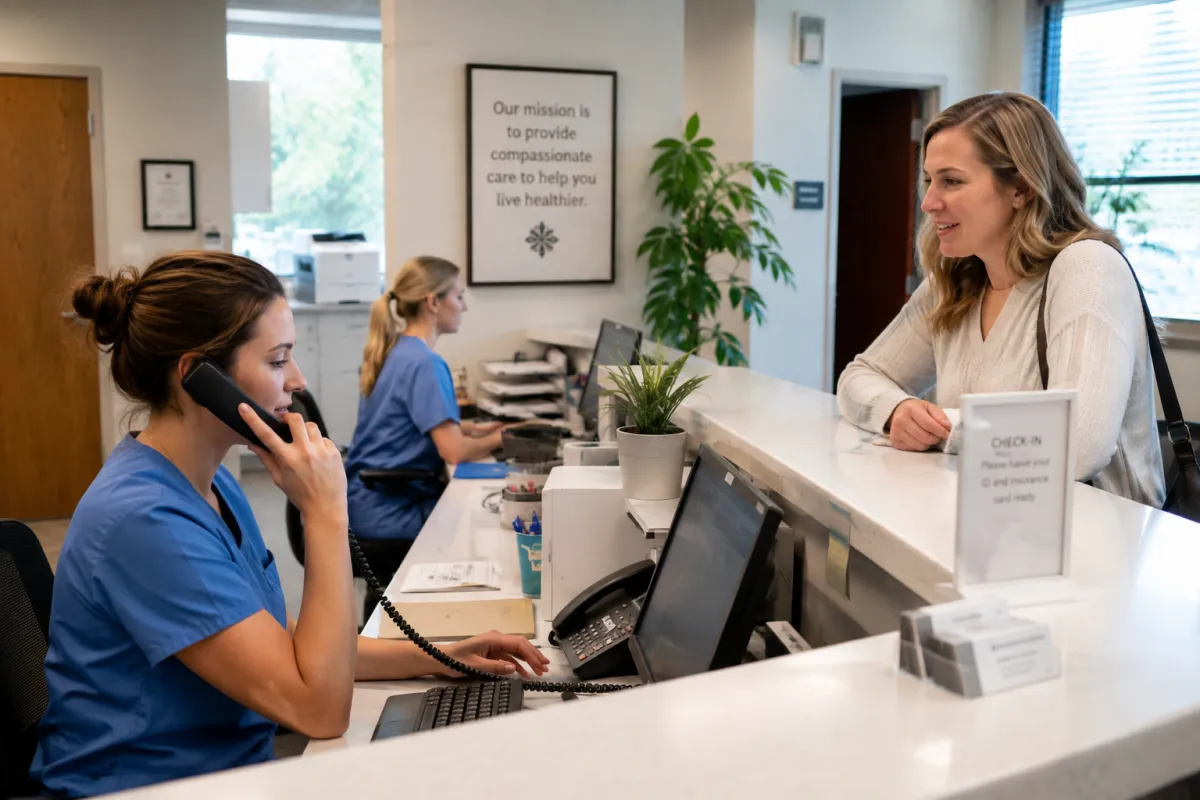
Picture your front desk mid-shift — checking a patient in, answering a scheduling question, collecting paperwork, and a second line ringing at the same time. Something gives. Usually it's the phone.
When a call goes unanswered, the work behind it doesn't disappear. It turns into a voicemail someone has to return later, a second call from the same patient, a scheduling delay, or a prospective patient who just calls the next practice on the list instead.
Before you decide the answer is another body at the front desk, it's worth actually looking at the pattern: when calls get missed, what percentage are routine, how many are just scheduling or rescheduling, what happens after hours, and how long it takes for a missed call to get returned. The fix might be better call routing, online scheduling, automated missed-call follow-up, an answering service, an AI voice tool, or some combination — the right answer depends on your practice, not on whatever's trending in a vendor's ad. But hiring shouldn't be the default fix for a phone system that's structurally set up to drop calls.
Scheduling is not one task — it's six or seven
An appointment isn't a single event. It's a request, a search for availability, a booking, a confirmation, a reminder, sometimes a reschedule, sometimes a cancellation, and occasionally a scramble to fill the slot that just opened up. Multiply that across a few thousand appointments a year, and what looks like a handful of small manual steps turns into a real chunk of somebody's week.
Watch for the places your team is repeatedly calling to confirm, re-sending the same information, chasing a non-response, or keeping a waitlist on a sticky note. A lot of that can run on autopilot while still leaving a clear path to a human whenever the situation actually calls for one. The point isn't to take your front desk out of patient communication — it's to stop their day from being consumed by communication that didn't need their judgment in the first place.
Walk your own intake process like a new patient would
Intake inefficiency tends to hide in plain sight because it's spread across several people, none of whom sees the whole picture. A patient fills out a form. Someone checks it. Something's missing. Someone follows up. The patient sends it. Someone re-enters or re-routes it somewhere else. Each step takes a few minutes — but a few minutes, repeated across every new patient, adds up fast.
Try walking through it yourself: can forms be completed before the visit? What actually happens when something's missing? Is anyone re-typing information the patient already gave you? Are reminders automatic, or does someone have to remember to send them? Does information move between your systems on its own, or does someone have to manually check that the last step actually happened?
Usually the biggest win here isn't a new piece of software — it's cutting out the handoffs between the tools you already have.
Follow-up that depends on someone remembering is a gap, not a system
Some of the most expensive operational holes aren't complicated at all. They're just inconsistent. A prospective patient needs a callback. Someone canceled and needs to be rebooked. A referral came in and never turned into an appointment. A patient didn't respond to the first message and nobody sent a second one.
When the next step depends entirely on a busy employee remembering it, it's competing for attention with whatever else is happening at the front desk that hour — and it usually loses. A well-built workflow triggers the next action on its own and only pulls in a person for the cases that genuinely need one. That gets you something hiring alone doesn't reliably deliver: consistency.
Billing and insurance have their own version of this problem
Not every part of the revenue cycle should be automated, and billing workflows vary enough between practices that a one-size answer doesn't really exist. But it's worth applying the same scrutiny here. Eligibility checks, missing information, claim-status follow-up, patient balances, repeated data entry — these eat real staff hours, quietly.
"Can we automate billing?" is too broad a question to be useful. A better one: which of the repeatable steps are pulling attention away from the people who need to be handling the actual exceptions? Automation tends to work best when it absorbs the predictable, high-volume work and hands your staff better visibility into the cases that genuinely need a human look.
Don't buy another tool until you understand the workflow
This is where a lot of practices make things harder on themselves than they need to be. They spot a problem and go straight to shopping for software. A few purchases later, the practice is running an EHR, a practice-management system, a phone system, a texting platform, a scheduling tool, a forms platform, a billing system, a CRM — and staff are still manually moving information between all of them by hand.
The issue usually isn't a lack of technology. It's that the technology already in place isn't talking to itself. The goal isn't more software — it's less friction between the systems you've already paid for.
Where AI actually fits into this
AI is genuinely useful in the right spot, but it shouldn't be the starting question. Don't begin with "where can we put AI in the practice?" Begin with "where is our team actually losing capacity?" — and only then figure out whether the right fix is a process change, a feature you already own and aren't using, straightforward automation, better integration between systems you already have, outsourcing, AI, or, yes, sometimes a new hire.
When hiring is the right answer, it's still worth getting there this way. That new person walks into a system that's already working, instead of becoming one more human patch on a process that was breaking before they showed up.
Measure before and after you change anything
Automation shouldn't get justified because it sounds modern. It should move a number you can actually point to: staff hours spent on repetitive work, percentage of calls answered, response time, appointments booked, no-show rate, intake completion rate, time spent on eligibility checks, claim turnaround, days in A/R, patient response time. If you can't name what's supposed to improve, you're probably not ready to pick a tool yet — you're ready to go back and finish mapping the workflow.
A simple exercise before you post the job listing
If your practice feels stretched, spend one week — before you open a requisition — writing down the repetitive work your team is actually doing. For each recurring task, note:
What's being done?
How often does it happen?
How many minutes does it take?
Does it require human judgment?
What happens if it doesn't get done?
Could it be eliminated, automated, integrated, or handled differently?
A task that takes five minutes but happens forty times a day is over sixteen hours of work a week — a part-time employee's worth of capacity, hiding inside a process nobody's looked at closely.
Growth doesn't have to mean more complexity
The goal was never to run a practice without people. It's the opposite: your people should spend their time where people actually add value — solving the unusual problem, sitting with a patient, making a judgment call, building the relationship. Systems should carry as much of the predictable work as they reasonably can, so your team isn't spending its best hours on work that never needed a person in the first place.
And when the next hire does become necessary, they're walking into a stronger operation — not standing in for a process that was already falling apart.
If patient volume jumped 20% next month, would your current systems absorb it — or would your phones, scheduling, intake, and follow-up start to buckle?
We're building the Practice Growth Readiness Assessment to help independent healthcare practices find out where their workflows are actually limiting capacity, and where automation or a process fix could open up room to grow before another hire is on the table.
Practice Growth Readiness Assessment — coming soon.
In the meantime, Accelerator Rev AI works with independent healthcare businesses to find the operational bottlenecks that are quietly limiting growth, and to figure out where better systems, automation, and practical AI implementation can create real, measurable capacity.